Guide
The service business guide to faster lead response
5 Sept 2026 · 9 min read
Speed of reply is the single highest-leverage number in a service business. Not ad spend, not pricing, not design — the minutes between an enquiry arriving and a useful answer going back. This guide is a playbook for making that number small and keeping it small.
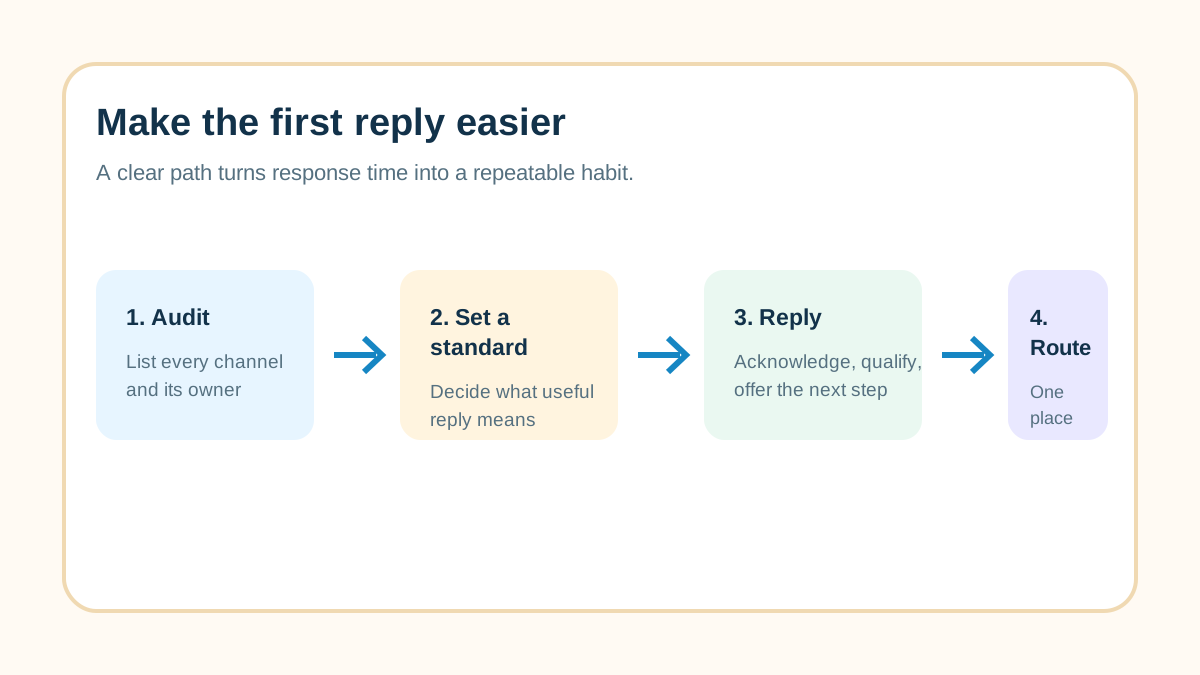
1. Audit where enquiries arrive today
You can't fix response time until you know every door a customer can knock on. List them all:
- Website forms and chat widgets
- WhatsApp Business (and personal WhatsApp customers message by mistake)
- Phone calls — including missed ones
- Google Business Profile messages and calls
- Facebook and Instagram messages and ad enquiries
- Email, if published anywhere
- Marketplace or listing-site enquiries, if you're on any
For each channel, note two things: who watches it, and how long a reply typically takes. Most businesses find at least one channel nobody owns, and one where replies quietly take days.
2. Set a response standard
Pick a standard you can defend: for example, every enquiry gets a useful reply within 5 minutes, 24/7. The exact number matters less than having one — a standard turns response time from an accident into a decision.
A useful reply is not a full quote. It's a response that:
- confirms you received the enquiry,
- asks the one or two questions needed to move forward (usually location and timing),
- sets the next step (a slot, a call, a visit).
Write the standard down. Share it with everyone who answers a phone.
3. Write first-reply templates per job type
Templates aren't coldness — they're speed. Prepare a short first reply for each common job type. A good template:
- Acknowledges the specific problem ("AC not cooling — we can help").
- Asks the qualifying questions (area, timing, model — whatever your trade needs).
- Offers the next step.
Keep them in a shared place everyone can reach. When templates exist, a great reply takes ten seconds. When they don't, every reply is written from scratch — and written slower.
4. Route enquiries to one place
Scattered enquiries are the reason replies are slow. Every channel that lands somewhere different is another thing to forget to check. Consolidate:
- Forward all calls to one number that's actually answered (or recorded and followed up).
- Point every form and ad to one inbox or system.
- Where possible, move conversations toward one channel your team actually lives in (usually WhatsApp).
If consolidating fully isn't practical yet, at minimum make one person responsible for sweeping all channels at fixed intervals — every 30 minutes during work hours.
5. Handle after-hours deliberately
Nights, Sundays and holidays are when emergencies happen and when your competitors are asleep. Decide the after-hours answer:
- An auto-reply that sets expectations and offers the next step ("We'll call you before 9 AM — reply with your area to book the first slot") is infinitely better than silence.
- Missed calls after hours should get a response first thing — before the inbox, before the new leads.
- If your trade is emergency-driven (plumbing, electrical, pest), consider real coverage: a rotation, a call-answering service, or automation that handles the first reply completely.
6. Measure three numbers
You can't improve what you don't look at. Three numbers tell the whole story:
- Enquiry → reply time. How many minutes pass before a useful response goes out. Watch the worst cases, not the average.
- Reply → conversation rate. How many first replies turn into a back-and-forth. A falling rate means replies aren't useful.
- Conversation → booking rate. How many conversations end in a booked job. A falling rate means qualifying or pricing needs work.
Review monthly. Fix what the numbers point at — nothing else.
7. Automate the first minutes
At some point, manual coverage stops scaling. Staff get busy, take leave, go on jobs — and the response standard quietly dies. This is where automation earns its place: an instant, helpful first reply on every enquiry, any hour, with follow-up that doesn't forget.
That's the specific gap Bluee fills — it responds in seconds, keeps the conversation moving, and hands your team qualified, ready conversations instead of cold enquiries.
Checklist
- [ ] Every enquiry channel listed, with an owner
- [ ] A written response standard (minutes, not hours)
- [ ] First-reply templates for top 5 job types
- [ ] All channels route to one watched place
- [ ] After-hours answer defined (not silence)
- [ ] Enquiry→reply time reviewed monthly
- [ ] Automation covering the first minutes, 24/7
Work through it top to bottom. The first three items alone will change your week. And if you'd rather have this running without building it yourself, book a demo — that's exactly what Bluee does.